
Can Engineered Hardwood Be Refinished? How to Tell If Yours Can
Many engineered floors can be sanded and refinished, but not all of them. The biggest factor is how thick the real-wood top layer is.
7 min read20 sources cited
On this page
The short answer
- Many can, but not all. The biggest factor is how thick the real-wood top layer (the wear layer) is.
- The National Wood Flooring Association’s general rule: under 2.5mm (3/32″) of wear layer should not be sanded.
- A careful sanding often removes less than 1/32″ of wood, and there is no fixed number of refinishes. Thickness, flatness and skill all change it.
- Too thin to sand? A professional maintenance coat can refresh a worn finish, as long as the wear hasn’t gone through to bare wood.
What engineered hardwood actually is
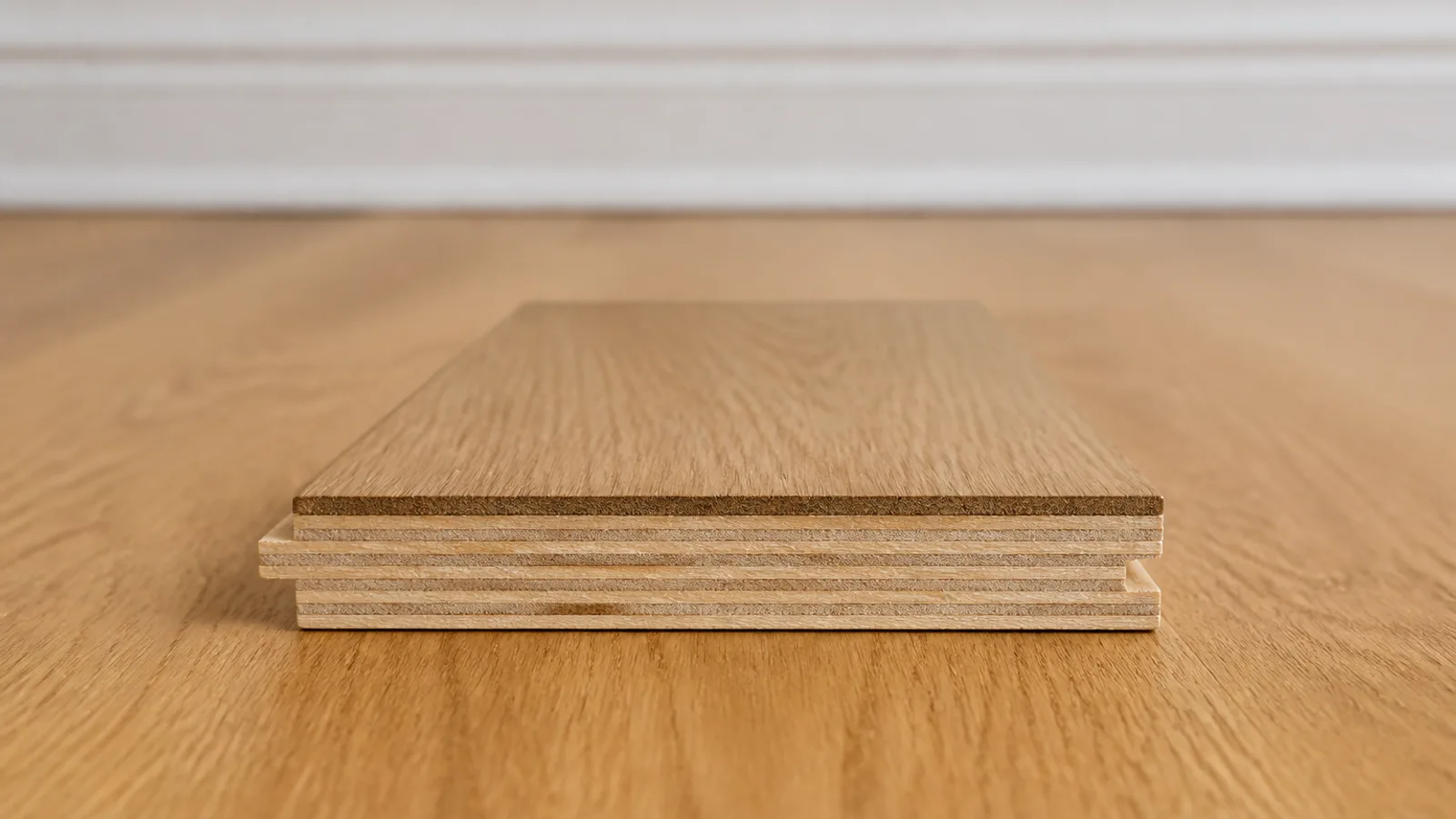
An engineered board is two things glued together. On top is a layer of real hardwood, called the wear layer (or lamella). Underneath is a core made from wood veneers, solid wood strips or a composite material.[1] Only the top layer is the hardwood you see, and it is the only layer that can be sanded.[15]
That layer varies a lot. Some engineered floors carry a paper-thin veneer peeled from the log. Others have a sawn wear layer up to ¼″ (6.35mm) thick, which is comparable to the wear layer on most ¾″ solid wood floors.[1] Wear layers are usually made one of three ways: sawn, sliced or rotary peeled.[12]
So “can engineered hardwood be refinished?” has no single answer. The National Wood Flooring Association (NWFA) puts it plainly: whatever the rest of the board is made of, the thickness of that top layer determines whether the floor can be refinished.[1]
The biggest factor: wear layer thickness
The NWFA’s sand-and-finish guidelines say that, in general, a floor with less than 2.5mm (3/32″) of wear layer should not be sanded.[2] That rule applies to any wood floor being considered for a refinish, solid or engineered.[1]
| Wear layer | What the sources say |
|---|---|
| Under 2.5mm (3/32″) | Should not be sanded, per NWFA guidelines.[2] These floors can usually be recoated instead.[8] |
| 3mm or more | “Ideally, 3mm or more shouldn’t be a problem,” according to wood flooring expert Bob Goldstein in Wood Floor Business, who still advises removing as little wood as possible.[3] |
| Up to ¼″ (6.35mm), sawn | Comparable to the wear layer on most ¾″ solid wood floors.[1] |
Some products rule sanding out entirely. Kährs, for example, says its slim 7mm and 10mm veneer floors can’t be re-sanded.[9] Consumer Reports sums up the range well: some engineered floors can be refinished once or twice, and some can’t be refinished at all.[8]
How many times can it be refinished?
There’s no reliable general number. The NWFA says the count depends on the contractor’s skill, the equipment, the wear layer thickness, and the floor’s flatness and condition.[4] It also notes that engineered floors can be sanded and refinished, just not as many times as solid wood.[5]
Here’s what the sources say about how much wood a sanding takes off:
- A normal sanding should remove a minimal amount of wood, often less than 1/32″ (under 1mm).[1]
- A flooring consultant puts a skilled professional’s full resand over a flat subfloor at 1/32 to 3/64 of an inch.[6]
- Humps and high spots mean more wood comes off in those areas.[1]
- Sanding out big bevels takes much more. A Bona technical trainer says he tells customers it means eliminating the top ⅛ inch of the floor.[7]
Manufacturers give figures for their own products, not for engineered floors in general. Kährs says engineered floors with a thick enough wear layer can be sanded up to four times, though not its thin veneer floors.[10] If you know your brand, that manufacturer’s guidance beats any rule of thumb. For solid floors, our guide to how sanding works covers how many sands a floor has left.
How to find out how thick yours is
This is the step that matters most, and it should happen before anyone switches on a sander. Start with the easy options:
- Find the brand. If you know the manufacturer and product, their instructions are the best information on how to sand and finish it.[11]
- Look for leftover boards in the basement, attic, garage or storage rooms. A spare plank lets you see the layers from the side.[1]
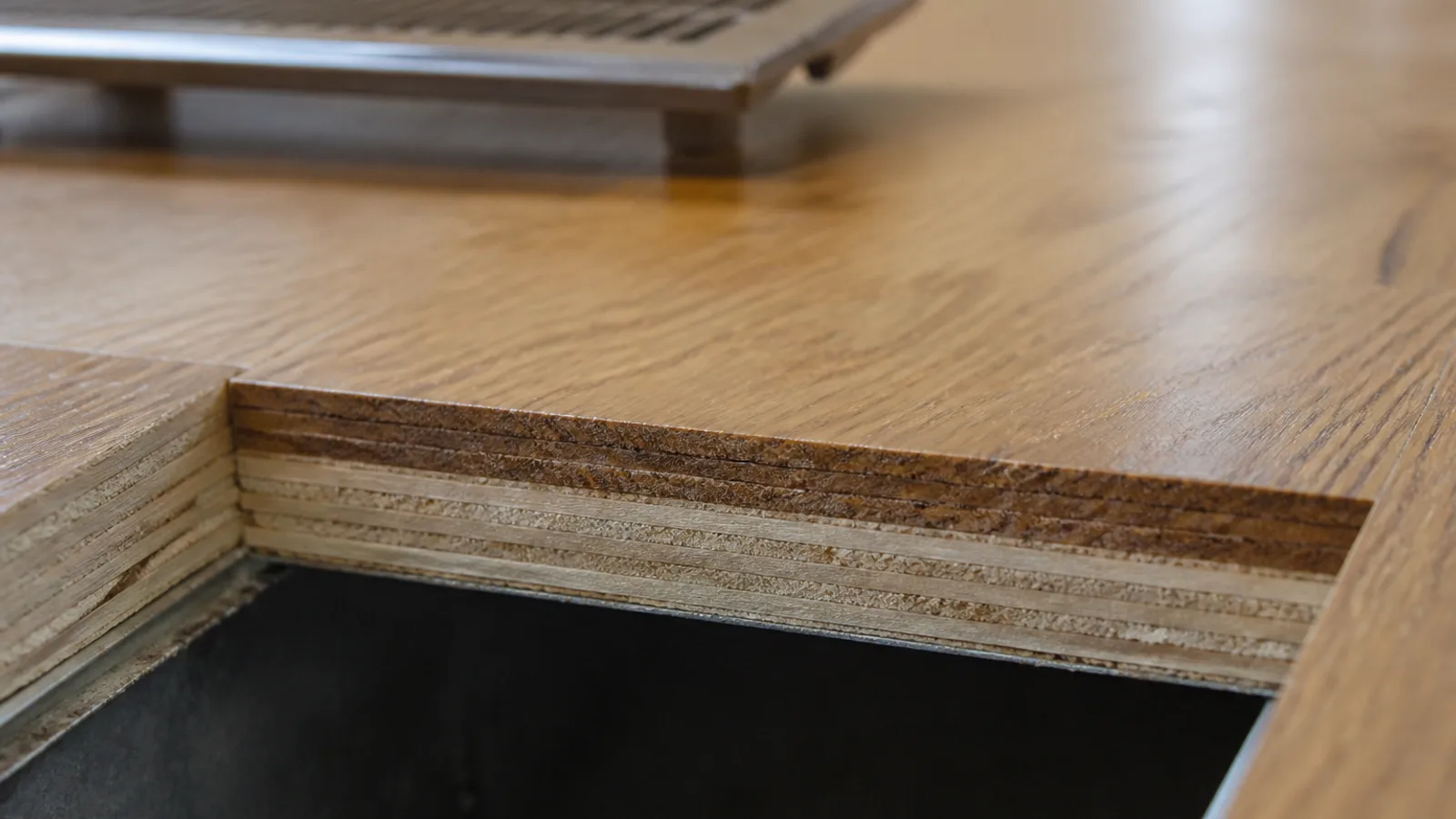
- Look at an edge. A floor register (heating vent) or a removed transition strip often lets you see the profile. So can pulling a length of quarter round or base shoe, or pulling back carpet where it meets the wood.[1]
A professional should check in several places, not just one.[13] Two cautions: the feeler-gauge trick contractors use between solid boards may not be reliable on some engineered floors, because the wear layer may not reach as deep as the tongue.[1] And as a last resort, with your permission, a pro may drill a small hole in a hidden spot, such as the inside corner of a closet, and plug it afterwards.[1][14]
What can go wrong when engineered floors are sanded
The big one is sanding through the veneer: cutting past the wear layer and into the core. The NWFA says it has exactly one cause, which is sanding beyond the thickness of the top layer.[15] When it happens, the best option may be creative touch-up with paints, dyes and graining tools. When that isn’t feasible, it often means replacing the floor.[1]
A few kinds of floor raise the risk:
- Bevelled edges. Sanding may remove a micro-bevel completely, which changes how the floor looks. If the bevel is going to be sanded out, the wear layer has to be measured from the bottom of it.[1] On deeply bevelled boards, even 3/32″ is sometimes not enough.[14]
- Textured surfaces. Hand-scraped, wire-brushed and sculpted floors are extremely difficult to sand, and often can’t be.[1]
- Factory finishes. High-abrasion finishes, like those on many prefinished floors, can be very difficult to sand.[13]
- Rotary-peeled veneer. One contractor warns that coarse sandpaper tears out the grain on this type, leaving an open, ugly look.[14]
- Some click-together floors. Mirage, for instance, says its floors can be sanded, with the exception of its Lock flooring.[16]
If yours is too thin: the maintenance coat
A thin wear layer doesn’t mean you’re stuck with a tired floor. The NWFA describes a maintenance coat: a professional cleans the existing finish, lightly sands it, and applies a fresh coat of finish.[19] Because it works on the finish rather than the wood, most engineered floors can be recoated regardless of wear layer thickness.[12]
A recoat has limits, though. It won’t remove:
- deep dings and scratches, sun discoloration, or water damage[20]
- dents from dog claws or damage along board edges[20]
The NWFA recommends a complete sand and refinish when there are deep scratches or dents, or when the finish has worn away to bare wood.[4] A simple trade tip helps tell the two apart: wring out a damp towel and rub it over a worn patch. If the wear disappears while it’s wet, a recoat will most likely do.[11] Our page on which scratches a recoat can hide goes into more detail.
The sensible order of operations
Put together, a sensible order is:
- Identify the product, or find a spot where the edge of a board is visible.
- Measure the wear layer, in more than one place.
- Check the warranty.
- Only then decide between a full sand and refinish, a maintenance coat, or replacing the damaged boards.
If you’re in Baltimore City or Baltimore County and not sure what you have, describe the floor in the form below and, if you know it, the brand. Knowing the wear layer first is the best way to keep a refinish from turning into a replacement.
Common questions
How many times can you refinish engineered hardwood?
There is no fixed number. The National Wood Flooring Association says it depends on the wear layer thickness, the floor’s flatness and condition, the equipment and the contractor’s skill, and that engineered floors cannot be sanded as many times as solid wood. Floors with less than 2.5mm (3/32″) of wear layer should not be sanded. Manufacturers give figures for their own products; Kährs, for example, says engineered floors with a thick enough wear layer can be sanded up to four times, while its thin 7mm and 10mm veneer floors cannot be re-sanded.
Can you refinish engineered hardwood floors without sanding?
You can refresh the finish without sanding into the wood. A professional maintenance coat cleans the existing finish, lightly sands the finish itself, and applies a fresh coat. Most engineered floors can be recoated regardless of wear layer thickness, but a recoat will not remove deep scratches, dents, sun discoloration or water damage, and wear that has reached bare wood needs a full sand and refinish.
Can you sand and refinish engineered hardwood floors?
Yes, if the wear layer is thick enough and the surface allows it. The NWFA’s general rule is that a wear layer under 2.5mm (3/32″) should not be sanded. Bevelled edges, hand-scraped or wire-brushed textures, and factory finishes all make sanding harder, and some products, including certain click-together floors, cannot be sanded. Measure the wear layer and check the manufacturer’s guidance first.
Sources
Every factual claim in this article comes from one of these.
- Refinish Your Floor · Hardwood Floors Magazine (NWFA), April 2022
- NWFA Launches Engineered Wood Flooring Refinishable Program · Hardwood Floors Magazine (NWFA), August 2022
- How Do You Know if a Wood Floor Can Be Sanded Again? · Wood Floor Business, March 2024
- Refinishing Your Floors · National Wood Flooring Association
- Types of Wood Floors · National Wood Flooring Association
- Wood Flooring Q&A: How Many Times Can a Wood Floor Be Sanded? · Wood Floor Business, July 2020
- Wood Flooring Q&A: How to Handle Bevels · Wood Floor Business, May 2022
- Flooring Buying Guide · Consumer Reports, September 2025
- Construction of Engineered Wood Floors · Kährs
- FAQ About Flooring · Kährs
- Recoating and Refinishing Factory-Finished Wood Flooring · Wood Floor Business
- Get on Board: How Engineered Flooring Is Made · Hardwood Floors Magazine (NWFA), October 2018
- Can the Floor Withstand a Resand? Sanding Factory-Finished Flooring · Hardwood Floors Magazine (NWFA), March 2019
- Tech Talk: What Is Your Approach to Resanding an Old Engineered Wood Floor? · Hardwood Floors Magazine (NWFA), April 2025
- Failures Unique to Engineered Wood Flooring · Hardwood Floors Magazine (NWFA), October 2018
- Mirage Products FAQ · Mirage
- Shaw Hardwood Limited Residential Warranty · Shaw Industries
- Densified Wood Flooring Warranty Guide · AHF Products (published on bruce.com)
- Give Your Floors a Refresh · National Wood Flooring Association
- Recoating Wood Flooring 101 · Wood Floor Business, August 2022